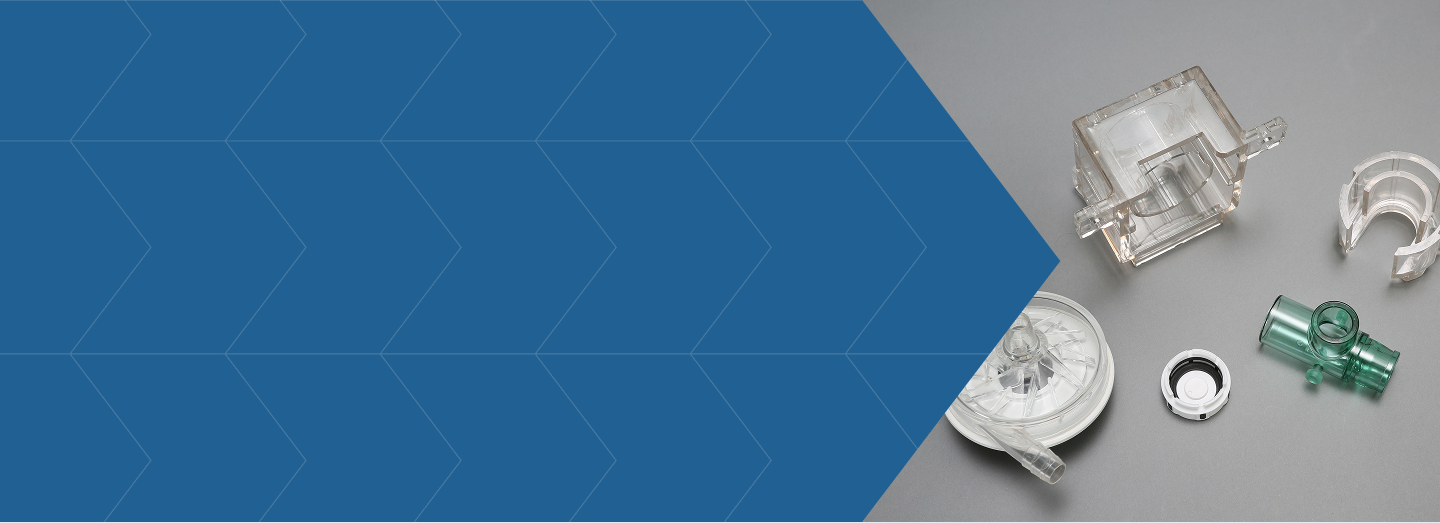
For engineers developing new products, choosing the right manufacturing process can have a significant impact on cost, quality, lead times, and long-term production success.
While machining, additive manufacturing, and injection molding each have their place, selecting the wrong process can create unnecessary costs, production delays, or performance challenges down the road.
The key is understanding when injection molded parts make sense—and when another manufacturing method may be a better fit.
At Dave Wheatley Enterprises (DWE), we work with engineers across defense, medical, industrial, and commercial markets to help optimize part designs for manufacturing. By evaluating performance requirements, production volumes, materials, and long-term costs early in the design process, teams can make better decisions before production ever begins.
What Are Injection Molded Parts?
Injection molded parts are plastic components produced by injecting molten resin into a precision-engineered mold cavity under high pressure.
Once the material cools and solidifies, the mold opens and the finished part is ejected. The process repeats rapidly, allowing manufacturers to produce large quantities of highly consistent components.
Injection molding is used to manufacture everything from medical device housings and industrial equipment components to aerospace parts, consumer products, and military equipment.
Because every part is produced from the same mold, injection molding offers exceptional repeatability and dimensional consistency—critical requirements when performance is on the line.
How the Injection Molding Process Works
While injection molding is often associated with high-volume production, the process itself is remarkably precise.
The typical workflow includes:
- Plastic resin is fed into the molding machine.
- The resin is heated until molten.
- Material is injected into a custom mold under pressure.
- The material cools and solidifies.
- The mold opens and the part is ejected.
- The cycle repeats.
Modern molding systems can produce thousands—or even millions—of identical parts with minimal variation.
For industries such as medical, defense, and industrial manufacturing, that consistency can significantly reduce quality risks while improving production efficiency.
Injection Molding vs Machining vs 3D Printing
Each manufacturing process offers unique advantages depending on the application.
| Manufacturing Method | Best For | Advantages | Limitations |
| Injection Molding | Medium to high-volume production | Low per-part cost, repeatability, scalability | Higher tooling investment |
| CNC Machining | Low-volume precision parts | Tight tolerances, no tooling required | Higher piece-part cost |
| 3D Printing | Prototypes and rapid iteration | Fast design validation, complex geometries | Limited scalability and material options |
For prototype development and design validation, 3D printing often provides the fastest path to testing.
For low-volume production requiring extremely tight tolerances, machining may be the preferred solution.
However, once production volumes increase, injection molded parts often become the most cost-effective and scalable option available.
Key Design Considerations for Injection Molded Parts
Successful injection molding starts long before production.
Design for Manufacturability (DFM) plays a critical role in determining whether a part can be produced efficiently, consistently, and cost-effectively.
Draft Angles
Draft angles allow parts to release cleanly from the mold after cooling.
Without sufficient draft, components may stick inside the mold, increasing cycle times and potentially damaging finished parts.
Even small draft adjustments can improve manufacturability and reduce production risk.
Wall Thickness
Uniform wall thickness helps ensure consistent cooling throughout the part.
Large variations in thickness can lead to:
- Warpage
- Sink marks
- Internal stress
- Dimensional instability
Maintaining consistent wall sections often improves both part quality and production efficiency.
Design for Manufacturability (DFM)
Many of the most expensive molding issues can be avoided during the design phase.
Early engineering collaboration helps identify opportunities to:
- Simplify part geometry
- Improve moldability
- Reduce tooling complexity
- Optimize material flow
- Lower production costs
At DWE, Design for Manufacturing and Assembly (DFMA) reviews help customers optimize every part of production before tooling begins.
Common Materials Used for Injection Molded Parts
Material selection has a direct impact on performance, durability, and manufacturing success.
Some of the most commonly used materials include:
ABS (Acrylonitrile Butadiene Styrene)
ABS offers excellent impact resistance, dimensional stability, and surface finish quality.
Common applications include:
- Equipment housings
- Consumer products
- Industrial components
Polypropylene (PP)
Polypropylene provides strong chemical resistance and flexibility while maintaining a low material cost.
Common applications include:
- Medical components
- Packaging
- Industrial assemblies
Polyethylene (PE)
Polyethylene offers excellent toughness and moisture resistance.
Common applications include:
- Fluid handling systems
- Protective components
- Industrial products
Engineers may also specify advanced engineered resins when applications require enhanced strength, temperature resistance, chemical compatibility, or regulatory compliance.
Selecting the right material early can help prevent costly redesigns later in the development cycle.
When Injection Molding Is the Right Choice
Injection molding is often the ideal solution when projects require:
- Production volumes in the thousands or greater
- Consistent part quality
- Tight repeatability requirements
- Lower long-term piece-part costs
- Complex geometries
- Reliable supply chain performance
While tooling investments are higher upfront compared to machining or 3D printing, the economics often shift dramatically as production volumes increase.
For organizations planning long-term manufacturing programs, injection molding frequently delivers the best combination of performance, scalability, and cost control.
Choosing the Right Manufacturing Partner
When every part must perform as intended, manufacturing decisions carry real consequences.
The most successful projects begin with engineering collaboration, thoughtful material selection, and a manufacturing partner that understands how design decisions affect production outcomes.
Whether you’re evaluating a new product design, transitioning from machining, or moving beyond prototyping, understanding when injection molded parts make sense can help reduce risk and improve long-term production success.
At DWE, we help customers optimize part designs, select the right materials, and build manufacturing strategies that deliver consistent results from prototype through production.
When performance matters, early collaboration can make all the difference.