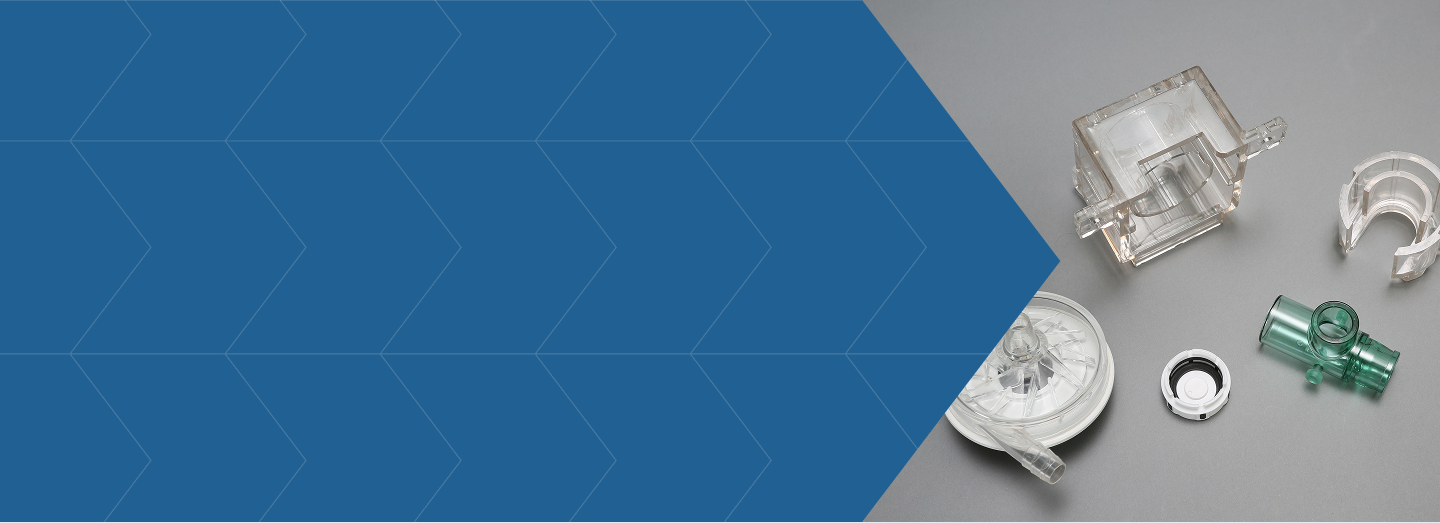
8 Ways to Minimize Defects for Plastic Medical Parts
For medical plastic components, part quality begins long before resin enters the mold. Geometry, material selection, wall thickness, draft, gating, and tolerance decisions can all influence how consistently a component can be manufactured.
Following proven injection molding design guidelines helps engineers identify potential problems while changes are still relatively easy to make. In medical injection molding, this early attention is especially valuable because dimensional consistency, material performance, assembly fit, and repeatability may all be critical to the finished product.
Here are several design considerations that can help reduce common molding defects and create a stronger path toward production.
1. Maintain Consistent Wall Thickness
Wall thickness has a direct impact on how molten plastic fills and cools within a mold. Large variations in thickness can create uneven cooling rates, increasing the potential for sink marks, warpage, internal stresses, and dimensional inconsistencies.
Whenever the application allows, engineers should maintain relatively uniform wall thickness throughout the component. When thickness changes are necessary, gradual transitions can improve material flow and cooling behavior.
Ribs, gussets, and other reinforcing features can also provide structural support without relying on excessively thick sections.
2. Incorporate Adequate Draft
Draft allows a molded component to release from the tool without excessive friction or force. Insufficient draft can cause sticking, drag marks, surface damage, or deformation during ejection.
The appropriate draft angle depends on factors such as part depth, surface finish, material, and tooling configuration. Engineers should consider drafting early in the plastic part design process, especially for deep walls and textured surfaces.
Early consideration can prevent geometry changes after tooling development begins.
3. Design Ribs and Bosses Carefully
Ribs and bosses can provide strength, support fasteners, and locate components within an assembly. Their dimensions and placement can also contribute to molding defects when they create thick material concentrations.
Oversized ribs or bosses may increase the risk of sink marks and uneven cooling. Designing these features with appropriate thickness, radii, and spacing helps maintain structural performance while promoting more consistent molding.
For medical assemblies, these decisions may also influence how reliably molded components align with mating parts.
4. Account for Material Flow and Gate Location
A component must be designed so molten resin can fill the cavity effectively before solidification.
Long flow paths, abrupt thickness changes, sharp corners, and complex geometries can make filling more difficult. Depending on the part and resin, poor flow conditions can contribute to short shots, weld lines, air traps, burn marks, and other defects.
Gate location is equally important. Gate placement affects how material enters the cavity, where flow fronts meet, and how pressure is distributed during filling and packing.
Collaboration between part designers and tooling specialists helps ensure these factors are evaluated together.
5. Use Radii Instead of Sharp Corners
Sharp internal corners can restrict material flow and create stress concentrations in molded parts. Adding appropriate radii helps resin move through the cavity more smoothly while improving stress distribution in the finished component.
Rounded transitions can also support better mold filling and reduce localized stress that may contribute to cracking or premature component failure.
This is particularly important when a medical plastic component will experience repeated loading, fastening, or assembly forces.
6. Specify Tolerances Based on Function
Tighter tolerances can increase tooling complexity, inspection requirements, and process control demands. Engineers should therefore determine which dimensions genuinely affect fit, function, sealing, alignment, or product performance.
Applying tight tolerances primarily to critical features allows the molding process to be developed around functional requirements without unnecessarily constraining every dimension.
Material shrinkage, mold design, component geometry, and processing conditions should also be considered when establishing realistic dimensional expectations.
7. Consider the Complete Assembly
Medical injection molding rarely exists in isolation. Molded components may eventually be welded, bonded, machined, decorated, assembled with electronics, or joined to other plastic and metal components.
Design decisions should account for these downstream operations.
Understanding how a component will be handled and assembled can influence feature placement, joining surfaces, tolerances, material selection, and accessibility. Evaluating the complete assembly early helps prevent a moldable component from becoming difficult to manufacture at a later stage.
8. Reduce Risk with Early Design for Manufacturability
A design for manufacturability review can identify potential molding challenges before production tooling is finalized. Engineers can evaluate geometry alongside material behavior, tooling strategy, assembly requirements, and expected production volumes.
Prototyping can provide another opportunity to test design assumptions, evaluate fit and function, and refine a component before moving toward full-scale production.
For medical injection molding, combining thoughtful part design with early manufacturing input creates a stronger foundation for quality and repeatability.
Bring Your Medical Injection Molding Design to DWE
Dave Wheatley Enterprises (DWE) supports plastic product development from engineering and prototyping through mold design, injection molding, assembly, and secondary operations. This integrated approach allows manufacturing considerations to be addressed throughout development instead of waiting until a design reaches production.
If you are developing a medical plastic component or troubleshooting a design with recurring molding defects, contact DWE to discuss your application and request a quote.